Assess leaks, gas pockets, debris, and wall condition in a single inspection under operational conditions
Introduction
Force mains are a pressurized component of gravity sewer systems that transport wastewater to a discharge point. Unfortunately, they are challenging to maintain, inspect, and repair due to the inability to take them offline for extended periods and the limited access points for inspection or maintenance.
Force main risks
A good understanding of the force main and its high-risk locations is an integral part of force main risk management. The vast majority of force main failures can be attributed to three main factors: internal corrosion, structure deterioration, and low scouring velocity.
- Internal Corrosion. Approximately 64 percent of force mains are composed of ferrous materials such as cast iron, ductile iron, and steel (EPA, 2010). The primary cause of failure in these force mains is internal corrosion caused by hydrogen sulfide (H2S) gas.
- Structure Deterioration. Force mains carry structures along their route, including air release valves (ARVs) at high points and blowoffs at low points. ARVs vent trapped gas and reduce the risk of sulfide corrosion. If an ARV fails, becomes submerged, or is not present, the resulting sulfide corrosion gradually deteriorates the metallic piping and valve. On a non-metallic force main these structures may be the only metallic components on the force main, and therefore the most likely points of failure.
- Low Scouring Velocity. The minimum self-cleaning velocity for a force main is two (2) feet per second. Below this velocity, deposits accumulate and restrict hydraulic capacity, and a moving deposit bed presents a risk of invert abrasion over time. Gas pocket formation is also more likely at lower velocities.
City of Crystal Lake project description
Crystal Lake owns and maintains thirty-one (31) wastewater lift stations and their associated force mains. This assessment covered the force main downstream of Lift Station #17. The purpose of this assessment was to detect any risks that may have emerged over time and provide the City with actionable intelligence concerning the force main. The assessment was performed in partnership with RJN Group, Inc.
Operational description
For the deployment, the pumps were stopped briefly to accumulate volume in the wet well and to allow insertion of the Pipers® through a check valve at the lift station. The pumps then ran continuously for the duration of the inspection. The force main remained in service throughout. A bar screen was set up at the outlet of the discharge manhole, with a crew member on standby with an extended catch basket available to collect the Pipers® upon arrival. Two (2) Pipers® were deployed and both were retrieved successfully. The 2 Pipers® allow for verification that all reported locations are related to the force main and not operational changes.
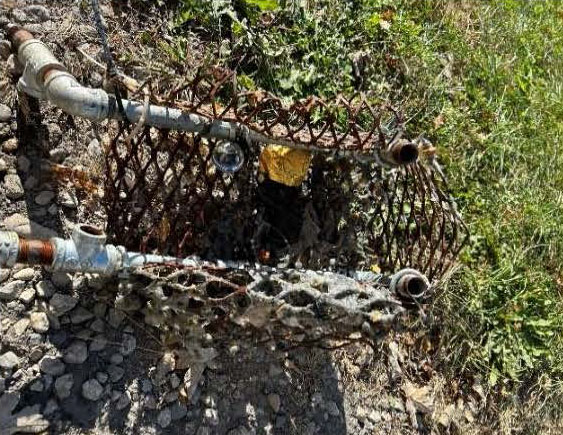
Inspection tool
Pipers®, INGU’s free-floating multi-sensor tools, provide an in-service condition assessment of force mains. In a single inspection, Pipers® identify gas pockets and leaks, determine the hydraulic grade line, and perform a magnetic inspection. The free-floating design allows Pipers® to navigate the force main’s flow without getting stuck in air release valves, tees, or deposits.
Project results
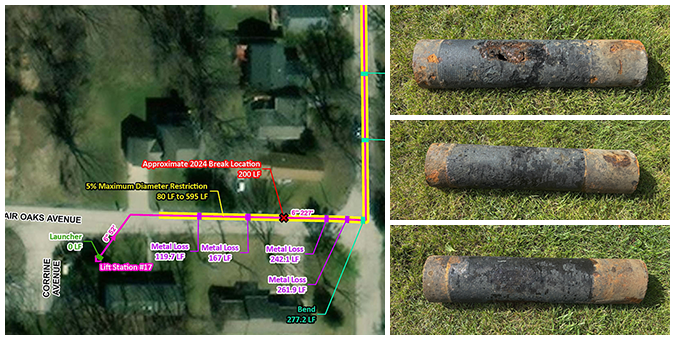
The Pipers® identified six (6) locations with a metal loss signature. These locations were assessed to be high risk as metal loss indicates at least 30% wall loss. The City of Crystal Lake excavated three (3) of the six locations. All three confirmed metal loss consistent with the reported signatures. The recovered cutouts are shown below.
The cutouts show that the corrosion is external and that the inside of the pipe is in good condition. The Pipers® detected no air pockets in this segment of the force main, and the external corrosion assessment found highly corrosive soils along the force main, which points to external corrosion as the primary cause of the wall loss.
Pipeline details
Pipeline Length | 1,100 feet |
Pipeline Diameter | 6 inches |
Pipeline Material | Cast Iron |
Content | Wastewater |
Location | United States |